
If you are a man past 50, there is a fair chance you know this routine without being told. You're asleep. Then you're not. There's that pressure, and you shuffle to the bathroom in the dark, stand there, and wait. When it finally comes, it's a trickle that barely makes a sound. You go back to bed. An hour later, you're up again.
By morning you've been up three, four, sometimes eight times. Maybe you check the map for restrooms before you agree to a drive.
And when you finally mentioned it to a doctor, chances are you heard some version of the same three words: it's just age.
Have you ever wondered why that sentence, meant to reassure, never quite does?
What "it's just age" leaves out
The number is real. Roughly half of men over 50 have an enlarged prostate, and by their seventies the figure climbs past eight in ten1. Waking repeatedly to urinate, known clinically as nocturia, is the symptom most men rate as the most bothersome of all, and the leading cause of broken sleep in older men2. So the condition is common. But common is not the same as explained.
Here is what most men are never shown. The prostate sits directly beneath the bladder and wraps around the urethra, the tube urine has to pass through3. As the gland enlarges, it squeezes that tube from the outside, the way a hand tightening around a garden hose thins the stream. That single mechanical fact accounts for most of what you've noticed: the weaker stream, the hesitation before it starts, the stop-and-start, the sense that you're never quite finished, the dribble afterward3.
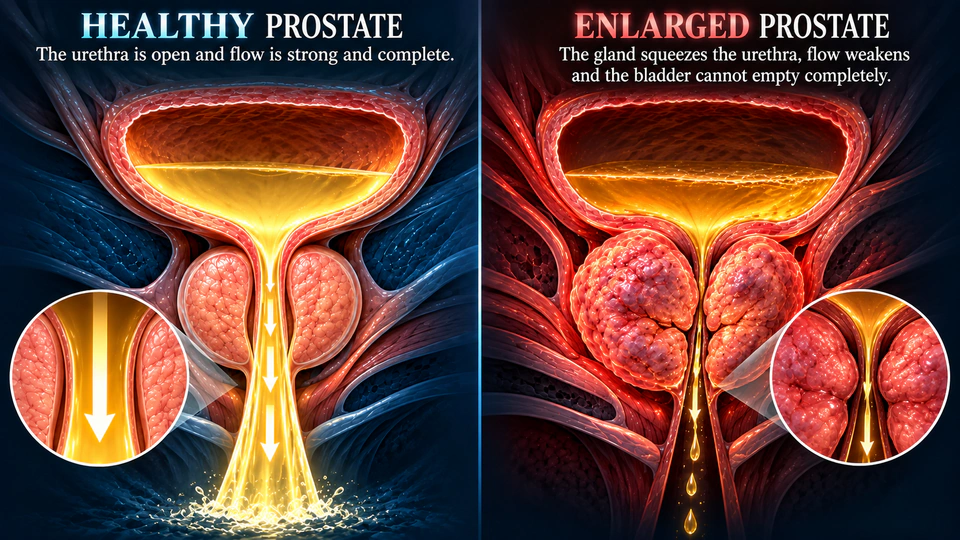
What it does not account for is the question underneath. If age were the whole story, why do two men of the same age, same diet, same town, end up with such different prostates? Why does one man reach 80 with a stream his grandson would envy while another is standing at the toilet at 55 waiting for the first drop?
That question is what Dr. Daniel Carter, a urology researcher with 27 years of practice, says he refused to keep ignoring after his own brother ended up in an emergency room. We'll come back to his brother. First, the tissue.
The toxic sponge
The prostate is not a passive lump. It is a gland with an unusual chemistry: zinc levels in its healthy tissue run three to ten times higher than in other soft tissues14, and, in Dr. Carter's account, it holds enough fatty tissue to behave like a sponge. Fatty tissue does something the liver and kidneys are built to prevent: it takes up and holds fat-soluble compounds rather than flushing them out12.
Persistent organic pollutants and other lipophilic chemicals are known to distribute into adipose tissue and stay there12. Separately, researchers have linked endocrine-disrupting chemicals, the class that includes bisphenol A and several pesticides, to the hormonal imbalance associated with prostate disease, from benign enlargement to cancer13. The picture is not settled science, and no reputable researcher claims a single compound explains BPH. But the direction of inquiry is telling: the gland that gives men the most trouble is also the gland best equipped to hoard what the rest of the body excretes.
Dr. Carter has a blunter name for the result. In his presentation he calls the accumulated material "toxic sludge," and he describes a chain that runs from decades of exposure, to storage in fatty prostate tissue, to chronic irritation, to inflammation and swelling, to a urethra compressed "like a vise." That framing is his, and we report it as his. What is not in dispute is what compression does once it starts.
If you're reading this and quietly running your own checklist, it probably looks something like this:
- Getting up two or more times a night to urinate
- A stream that has weakened, or now starts and stops
- Standing there, straining, waiting for the first drop
- The feeling the bladder never fully empties
- Dribbling after you think you're done
- Erections that have grown weaker, or a drive that has quietly gone missing
The last one is the sign almost no man connects to the other five.
Why the pills manage the problem instead of ending it
This is the part that changes how most men see their medicine cabinet.
Alpha-blockers relax the smooth muscle around the prostate and bladder neck so urine passes more easily. They do not shrink the gland. One alpha-blocker's FDA label lists dizziness and abnormal ejaculation among the most common side effects4. 5-alpha-reductase inhibitors (5-ARIs) work differently: they block the conversion of testosterone to DHT, which can slowly reduce gland volume over months, and the FDA labels of two 5-ARIs warn of decreased libido, erectile dysfunction and ejaculation disorders56. Neither class was designed to remove anything from the tissue. They adjust muscle tone or hormone signaling around a problem that stays where it is3.
That is not a scandal. It is simply what the drugs are. But it explains a pattern millions of men have lived through without anyone naming it. Has your dose gone up? Was a second drug added when the first one "stopped working"? Did anyone mention, at the first appointment, that the relief would last exactly as long as the prescription did?
And when the drugs run out of room, the conversation turns to surgery. Transurethral resection of the prostate (TURP) shaves tissue from inside the gland. It works for flow. It also produces ejaculatory dysfunction in about two-thirds of the men who undergo it, and carries a smaller risk of incontinence and erectile dysfunction7. For a man who has spent two years protecting what remains of his intimate life, that is not a small footnote.
What each option does, and what it leaves untouched
Swipe sideways to see the full table.
| Approach | How it works | Acts on the buildup in tissue? | Common trade-offs | Time to effect |
|---|---|---|---|---|
| Alpha-blockers | Relax smooth muscle around prostate and bladder neck4 | No | Dizziness, abnormal ejaculation; symptoms return when stopped4 | Days |
| 5-ARIs | Block testosterone→DHT conversion; may shrink gland over time3 | No | Lower libido, erectile and ejaculation problems56 | 6–12 months |
| TURP surgery | Removes tissue from inside the gland7 | No removes tissue; cause of enlargement unchanged | Ejaculatory dysfunction in most patients; incontinence and ED risk; weeks of recovery7 | Weeks after recovery |
| Single-ingredient supplements | One botanical, usually saw palmetto | Not designed to | Large trial and Cochrane review: saw palmetto alone no better than placebo9 | Variable |
| Doing nothing | — | No | Chronic incomplete emptying raises risk of infection, bladder damage and kidney problems3 | Progressive |
| Three-stage botanical protocol flush → repair → protect | Sequenced botanicals; described in the presentation | Designed to per the presenter | Requires the full protocol; not a substitute for medical care | First changes reported at 72 h–2 weeks per presentation |
The first five rows reflect published labels and reviews. The final row describes the approach as presented by Dr. Carter and has not been independently evaluated.
Dr. Carter explains the mechanism, and names the three plants, in a free video presentation. It asks for no email and you can stop it whenever you like.
Watch the free presentationFree · No sign-up · Presented by the protocol's developer
The night a urologist stopped trusting his own prescriptions
Dr. Carter says the approach grew out of his older brother Frank's case. Frank, 62, had stayed on the standard BPH medications his brother prescribed while his symptoms kept progressing, and Dr. Carter came to believe he was managing the problem rather than treating its cause.
Would you know, today, whether your treatment is fixing something or managing something?
Flush, repair, protect: the order matters
The approach Dr. Carter describes rests on three botanicals with long histories and a real, if uneven, research record: stinging nettle root, which has been tested against placebo for lower urinary tract symptoms8; saw palmetto berry, used traditionally for urinary complaints, although a large high-dose trial and a Cochrane review found the single extract no more effective than placebo9; and pumpkin seed, which improved symptom scores in a Korean trial10 but produced mixed results in a larger one-year placebo-controlled study11. What he adds is a sequence.
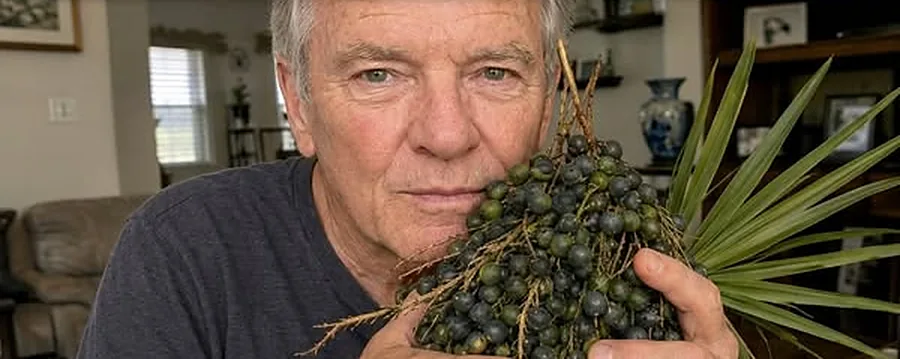
- FlushHelp the body bind and clear what has accumulated in the tissue.
- RepairSupply the compounds the inflamed tissue needs to recover and support normal hormone balance.
- ProtectBuild resistance to new accumulation so the result holds.
Trying to repair the prostate before flushing out the sludge is like painting a wall while water is still leaking behind it.
That, he argues, is why single-plant supplements so often disappoint, and why saw palmetto alone has fared so poorly against placebo: they attempt step two without step one.
The exact order, dosing and timing are the substance of his presentation, and we won't reproduce them here. What we can report is what he says happened when he tried it on his brother.
The order is the one thing we can't show you here. In a free video presentation, Dr. Carter explains which plant comes first, why, and how the three stages are timed.
See the three steps in orderFree · No sign-up · Presented by the protocol's developer
What the presentation reports
According to Dr. Carter, Frank slept four uninterrupted hours within 72 hours, something he hadn't done in months. By day seven his nightly trips had fallen from eight to ten down to one or two. At two weeks his stream was stronger and he could empty fully. By week eight he slept through the night for the first time in over five years, and his PSA had fallen from 8.7 to 5.2. At six months his PSA was 3.8, his prostate had returned to its normal size, and the surgery that had been scheduled was cancelled.
Dr. Carter then reports using the protocol with 388 men who had failed conventional treatment, some already scheduled for surgery. He states that 94% reduced nighttime trips from an average of six to one or none, 91% regained a stronger stream with complete emptying, and 88% showed a measurable reduction in prostate size within eight weeks.
He also cites an epidemiological study of Amish men with far lower rates of prostate enlargement. We could not locate that study; what is documented is that Amish communities in Ohio show markedly lower rates of several cancers than the general population15, which is consistent with a lifestyle effect but says nothing specific about the prostate.
These figures come from the presentation. They have not been published in a peer-reviewed journal and we have not verified them. We include them because they are the claim you will be evaluating if you watch, and you deserve to know what it is before you do.
Who this is for
If you have been on an alpha-blocker or a 5-ARI for more than a year and still get up at night, the presentation addresses you directly, because the mechanism it describes is the one those drugs leave untouched. If a urologist has raised surgery, it is worth 40 minutes of your time before the date is set; the men Dr. Carter describes were in that position. And if you are the man who has read everything, who has fourteen tabs open and still cannot decide, the presentation gives you a causal model to argue with, which is more than most pages offer.
It is not for men in acute retention, with blood in the urine, or with a PSA their doctor is actively investigating. Those need a physician this week, not a video.
Watch the free presentation
Dr. Carter explains the mechanism, names the three plants, and shows the order they are taken in. It costs nothing, asks for no email, and you can stop it whenever you like. In it you will hear:
- Why the prostate holds on to what the liver and kidneys clear, and what that does to the urethra over decades
- The three plants, and why the order they are taken in decides whether the protocol works
- What happened to Frank at 72 hours, day seven, week eight and month six
- Why single-ingredient supplements, and the pills, were never designed to touch the cause
Free · No sign-up · Presented by the protocol's developer
P.S. If you get up more than once a night, or if you wait for the stream to start, do not file it under "age" one more year. Watch, and decide for yourself.
Questions men ask before they watch
Is an enlarged prostate the same as prostate cancer?
No. Benign prostatic hyperplasia is, by definition, non-cancerous growth of the gland3. The two conditions can coexist, which is why a rising PSA should always be discussed with a physician, but the symptoms described on this page are those of BPH.
Why do I get up at night if I stop drinking water after dinner?
Because the problem is usually not the volume of fluid but the bladder's inability to empty. When the enlarged gland narrows the urethra, urine remains after each trip, so the bladder signals "full" again far sooner than it should3.
Can botanicals like nettle or saw palmetto be taken alongside BPH medication?
Many men do, but this is a question for your prescriber, not a web page. Bring the ingredient list to the appointment. Do not stop or change a prescription on your own.
How long before a three-stage approach shows anything?
Dr. Carter's presentation reports first changes in sleep and nighttime frequency within 72 hours to two weeks and describes a six-month protocol for the full sequence. Those timelines are his account, not a guarantee.
I already have surgery on the calendar. Is it too late to look at this?
The men in the presentation who avoided surgery were, by Dr. Carter's description, scheduled for it. Whether that applies to you is a decision for you and your urologist; watching first costs nothing and may sharpen the questions you ask.
Is the presentation really free, and who made it?
Yes. It is a free video presentation produced by the developer of the protocol and the company that markets it. There is no fee to watch and no registration. This page is an advertorial that receives compensation if you later purchase; see the disclosure below.
Why haven't I heard any of this from my urologist?
A 12-minute appointment has room for a prescription, not for tissue chemistry. Dr. Carter also states that medical journals declined to review his findings; that is his claim and we have no way to confirm it. What is documented is that current first-line drugs act on muscle tone and hormones, not on tissue accumulation456.
Is waking once a night normal after 50?
Once can be. Nocturia affects roughly three in ten men in their sixties and four in ten past seventy2; two or more times most nights is the point at which clinicians treat it as a symptom to investigate rather than a quirk of age.
About this report
Men's Health Report is an advertorial publication operated by HealthInsight News, New York. This article was written to introduce a free video presentation about a three-stage botanical protocol for benign prostatic hyperplasia (BPH). Every factual statement about prevalence, anatomy, medications, surgery and botanical research is linked to a primary source (National Institutes of Health, FDA-approved labels on DailyMed, peer-reviewed journals on PubMed Central). Statements attributed to Dr. Daniel Carter or to "the presentation" are the presenter's account and are labeled as unverified. We receive compensation if you purchase a product after watching the presentation; this does not change the sources cited. Last reviewed .
Sources
All links open the original publisher. Statements attributed to Dr. Carter or to "the presentation" are not covered by these sources.
- Risk factors for benign prostatic hyperplasia: a comprehensive review. PMC / National Institutes of Health. pmc.ncbi.nlm.nih.gov/articles/PMC12245072
- The evaluation of nocturia in patients with lower urinary tract symptoms suggestive of BPH: a randomized placebo-controlled study. BMC Urology, 2018, via PMC. pmc.ncbi.nlm.nih.gov/articles/PMC6293598
- Enlarged Prostate (Benign Prostatic Hyperplasia). National Institute of Diabetes and Digestive and Kidney Diseases (NIDDK), NIH. niddk.nih.gov
- Alpha-blocker capsules, FDA-approved prescribing information. DailyMed, U.S. National Library of Medicine. dailymed.nlm.nih.gov
- 5-alpha-reductase inhibitor tablets, FDA-approved prescribing information. DailyMed. dailymed.nlm.nih.gov
- 5-alpha-reductase inhibitor capsules, FDA-approved prescribing information. DailyMed. dailymed.nlm.nih.gov
- Ejaculatory dysfunction in the treatment of lower urinary tract symptoms. Translational Andrology and Urology, via PMC. pmc.ncbi.nlm.nih.gov/articles/PMC5002000
- The efficacy of stinging nettle (Urtica dioica) in patients with benign prostatic hyperplasia: a randomized double-blind study in 100 patients. Iranian Red Crescent Medical Journal, via PMC. pmc.ncbi.nlm.nih.gov/articles/PMC3589769
- Benign Prostatic Hyperplasia and Complementary and Integrative Approaches. National Center for Complementary and Integrative Health (NCCIH), NIH. nccih.nih.gov
- Effects of pumpkin seed oil and saw palmetto oil in Korean men with symptomatic benign prostatic hyperplasia. Nutrition Research and Practice, via PMC. pmc.ncbi.nlm.nih.gov/articles/PMC2809240
- Effects of pumpkin seed in men with lower urinary tract symptoms due to BPH in the one-year, randomized, placebo-controlled GRANU study. Urologia Internationalis. karger.com
- Toxicological function of adipose tissue: focus on persistent organic pollutants. PMC. pmc.ncbi.nlm.nih.gov/articles/PMC3569688
- Combined effects of different endocrine-disrupting chemicals (EDCs) on prostate gland. PMC. pmc.ncbi.nlm.nih.gov/articles/PMC8471191
- Zinc and zinc transporters in normal prostate function and the pathogenesis of prostate cancer. PMC. pmc.ncbi.nlm.nih.gov/articles/PMC4461430
- Amish have lower rates of cancer, Ohio State study shows (summary of Westman et al., Cancer Causes & Control, 2010). The Ohio State University Wexner Medical Center. wexnermedical.osu.edu